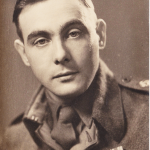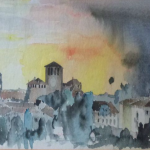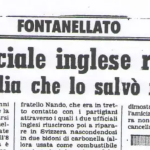
Summary of Peter Watson, part 2
The second part of Peter D. Watson’s story follows on from “Mountain Highway”, which covered his capture in North Africa in June 1942, imprisonment in Italy at PG 49 Fontanellato and recapture in March 1944. “The End of an Odyssey”, deals with the period from his arrival in Germany. He was held initially in Stalag VII A Moosberg, where he took part in a failed attempt to dig a tunnel and met Lord Harewood (nephew of King George VI). In about September 1944 he was transferred to Oflag 79, near Brunswick, and the memoir includes diary entries from 3 April 1945 that record the camp’s liberation by the US 125 Cav. Regt on 12 April 1945. On 23 April, the former POWs were flown out on Dakotas to a transit camp in Brussels. The descriptions of camp life are good and the diary entries recording the uncertainties and worries leading up to and after liberation are particularly vivid.
The full story follows, in two versions. The version in the first window below is the original scanned version of the story. In the second window below is the transcribed version in plain text.
THE END OF AN ODYSSEY
I
I stood high in the foothills of the Himalayas, looking down on the shimmering heat of the great plain of India, and knew that my life was about to change. Europe was at war; my battalion was mobilizing; and I was at the start of an adventure which, I dreamed, would take me victoriously through the turmoil of battle to my distant home in England. I was eager to start; to become involved in the war before the enemy should be defeated and others take all the glory, for my vision of the future was compounded of stories told of the first world war and the punitive expeditions of the Empire. I never thought that I was about to set out on an Odyssey which would take over five long and weary years to complete.
At first there were delays, frustrating delays, before we entrained for the dusty, three day, journey across the Sind Desert to Karachi and the sea. By then, the visions of glory had faded; our armies of the West had been defeated; our cities lay in ruins; and we expected, at any moment, an announcement that King and Government had fled to Ottawa. The clear certainty of that September evening of 1939 had become confused, although I was still convinced that one day, somehow, our forces would be victorious.
Now I was setting out on an Odyssey whose goal was England, but whose path was unclear. Before it was over, I was to stand on the great ziggurats of Ur and of Babylon; walk beside the Tigris in Bagdad and stroll down the street called Straight in the bazaar of Damascus; I was to meet, in Beirut, the girl I had loved in Lahore and walk with her in the moonlight beside the white pillars of Baalbek; I was to visit the Holy Sepulchre and travel the harsh desert road down to Jericho; I was to cross the black lava belt of Jordan, through the green and yellow citrus groves of Palestine, down to Egypt, the desert and the war. In Mountain Highway I have described how I was captured and how, as a prisoner of war, I was taken to Italy, eventually finding myself in a camp near Parma; how I tried to change my fate by walking back down the way I had come, only to be taken again and set once more on my destined path to Germany.
This is not a description of my Odyssey, but only of its end, for the beginnings and endings of matters has always fascinated me. Once a course is set its continuance can be predicted, but how it will end and to what new beginnings that end will give rise, are matters for speculation and surprise. When I was young, the pattern of society seemed solid and immutable, my life at each stage, so certain and pre-determined, that I could not imagine the existing order being disrupted and I could see clearly where I was going. Now that I am old, I am very aware of the fragility of the existing order of things and how easily it can be shattered and brought to an end.
As a prisoner in Italy, each monotonous day so exactly like the last, it was hard to accept that it could all end with dramatic suddenness. When, again, I became a prisoner, now of the Germans, the dreary routine of the camps closed in on me once more and the end, although obviously there had to be an end, was but a distant fantasy. After a year in German prisons however the existing order was visibly crumbling; the Allies were beginning their wide sweep across the North German plain, and their arrival could be calculated, at first in months and then in weeks. Change became a reality and I began, again, to keep a diary for, happily or fatally, my Odyssey was drawing to a close and I felt the need to record the moment of its ending.
As I re-read my diary, the emotions come flooding back. The rising hope and accompanying fear; the uncertainty and discomfort; the hunger, above all the hunger of those last starving days. Those who have not suffered a prison existence cannot readily share those emotions, for the context is missing; the atmosphere, the relationships, the many trivial things which made up our life. Before recording my diary therefore I will try, very briefly, to set out some of the background to our life and how it was that I came to be in Oflag 79, near Brunswick, on 3 April 1945, the day my diary opens.
II
We came over the Alps in cattle trucks, well-guarded by German soldiers going home on leave, divided from us by a barbed wire fence running diagonally across the truck. We were shunted into a siding near the village of Moosburg, outside Munich. The sliding door on our side of the fence was pushed back, and we were ordered out to stand in line, facing our guards, reinforced by men and dogs from the camp. A prisoner stepped out of line, an Alsatian leaped forward bringing him to the ground and he was dragged away. Not an auspicious start.
After we had been counted and receipts given, no doubt, in triplicate, we were marched into Stalag VII A, through the iron gates with their ironic inscription ‘Nach Berlin’. Moosburg was a strange place, there must have been about 18,000 prisoners in its hundreds of wooden huts, stretching away as far as we could see. The huts were grouped into small compounds, each compound surrounded by a high barbed wire fence, leaving straight roads between, like a Roman camp. Our compound was at the far end, near the perimeter, with its double fence, between which the guard dogs were set loose at night, and high watch towers with their machine guns and searchlights. At night, unless the air raid warning had gone, the perimeter would be brightly lit, and the searchlights would swing to and fro in constant inquiry.
Our huts were fitted with two tier bunks and wood shaving filled mattresses and we longed to lie down. But before we could rest, we had to be deloused. We were marched back to the administration compound, near the entrance, and herded through the long shower hut, guards watching to ensure that we washed thoroughly and passed a little man sitting on a stool, who dabbed a yellow liquid on our genitals, which made them sting violently for several hours. Then we were given clean uniforms, provided by the Red Cross, and marched back to our huts, which were to be my home for the next six months.
I might have been back in Capua, only the names were different. We were now ‘Kriegies’ instead of ‘PGs’ and guarded by ‘Goons’ in place of ‘Ites’, but the huts, the routine, and the food, were but little changed. Warm water for breakfast, a watery soup, and some bread for lunch, two potatoes and a dab of margarine for supper; the menu rarely altered. We did however receive a fairly regular supply of Red Cross parcels, although we had to share them, one parcel each week between four or six prisoners. We divided ourselves into syndicates, both for the sharing out of the parcels and for the scrupulous division of the black bread, which yielded a daily ration the equivalent of one small roll.
The parcels, which were vital to our health and at times to our existence, provided tins of meat which we could add to the Goon soup; tea, sugar, and dried milk; and various foods such as semolina, which we could cook up. This required a stufa, a little stove which we made out of KLIM tins and fuelled from spare bed boards, the contents of our mattresses, or anything burnable we could glean. Our lives revolved around the stufa. Each syndicate spending hours on its knees, enveloped in smoke, as though praying to an incense wreathed idol; an idol which, if sufficiently fed and worshiped, might, should the omens be right, produce at the end of the day a mouthful or two of some eagerly awaited, but quite unidentifiable, concoction. Some of the more mechanically minded constructed elaborate blowers for their stufas, revolving fans made out of tin. Tins were also turned into mugs with rope insulated handles (for the Goons issued none) into boxes for keeping things in, and into many weird and wonderful contraptions, including the ventilation system for our tunnel.
Next to our compound was one which was empty and beyond that lay the perimeter fence. The huts were raised off the ground, leaving a gap of about a foot, and in the corner of one of the huts was an old cast iron stove. We found that we could move the stove and prise up the boards beneath it, so gaining access to the space below. All we then had to do was to dig a tunnel to the nearest hut in the next compound, about 40 feet, where we could come up for air and then dig another tunnel under the perimeter fence. Plans were approved by the Escape Committee and we set to work.
As I have remarked before, the trouble with tunnels is the disposal of the soil. In this case it had to be spread beneath the hut, and I became a ‘stooge’, responsible for this difficult and very claustrophobic task. A hole was excavated under the stove and a tunnel opened out at the bottom. The earth was shovelled back over the lip of the hole and I, lying flat under the hut floor, pulled the soil back under my stomach and dispersed it with my feet. There was hardly room to lift my head.
The Germans were always wandering round the compound and one of them took to the habit of sitting in the room with the stove, which had to be pushed back into position as soon as our sentries reported that he was moving in our direction. Operations would then be suspended, and we would lie silent until he had gone. My constant fear, in the confined space under the hut, was that the Goons would put in their dogs. They had a nasty habit of sending their dogs in under the huts to discourage digging, and the thought of coming face to face with an angry Alsatian was not particularly reassuring.
We made slow progress, because only one man could work at the tunnel face at a time. Lying at the end of the tunnel, he would pick at the earth and push it back to a man lying behind him and so back to the top of the hole, where I would take over. As the tunnel grew in length it was revetted with bed boards and lit by a borrowed bulb connected with our electricity supply and, to remove the earth, a small sledge was constructed which could be pulled to and fro by a string. Ventilation however became a problem; the air at the working face quickly became foul, and an air tube with a blower had to be made out of tins. Even so, there was still insufficient fresh air to work in, and it was decided to put up a small tube when we reached an electricity pole about halfway to the next compound.
When we looked out, the morning after we reached the pole, we saw, to our alarm, that it was leaning over at a distinct angle. The tunnel had undermined its foundations. After we had been formed up for morning roll call we all leaned over in sympathy with the pole, in the hope that the Goons, known to be of little brain, would think that it was they who were walking at an angle and overlook the pole. It was a vain hope! In a moment, the compound was flooded by guards and dogs. We were counted so many times that we missed our rations, and a Russian working party was sent in to fill in the tunnel. I must admit to being a little relieved. I tend to suffer a bit from claustrophobia and working under that hut had been very unpleasant.
There seemed to be no other practical means of escape, although I believe that one officer did try to walk out through the main gate pretending to be a French worker, so we turned our minds to entertainment. We formed a company, of which I was stage manager, to put on a weekly revue. We had several professional actors with us and the standard of the performances was quite high. We made a stage by pushing the tables together and managed to scrounge some material to make a curtain. After a time, we grew more ambitious and mounted a very professional performance of Fanny by Gaslight, which we got permission to put on for some of the British ORs in the camp (and the English speaking German officers). The performance was put on in a lecture hut, outside our compound, which had a proper stage and lighting.
This brought us into contact with the French, who ran the hut, and, indeed, who practically ran the entire camp. The French were mostly ‘volunteer’ labour and did most of the work about the camp. They were better fed and had greater freedom than the normal prisoners and ran the black market. The currency in the black market, which was widespread in Germany at that time, was cigarettes. Cigarettes from our Red Cross parcels would buy almost anything which could be smuggled into the camp. They must have changed hands many times before anyone actually smoked them, if anyone ever did, and after a few transactions they must have got a bit bedraggled. But I suppose that there must have been someone at the end of the chain, perhaps in some Berlin nightclub, who actually opened a packet and lit up, greatly impressing his girlfriend. The contact with the French was very valuable, but they were not to be trusted. Many of them worked in more than one sense for the Germans.
For us, Stalag VII A was supposed to be a transit camp and from time to time small parties would be sent off to proper Oflags. Peter Stericker, who had been with me on the Mountain Highway, left in September, but our numbers were kept up by new arrivals. One newcomer was Lord Harewood, who caused quite a stir among the Germans, who are always impressed by a title. They set aside a small room for his sole use, provided a proper bed and bedding, a chair and a mirror, and the Commandant came to see him settled in. Of course, he did not use the bed and bunked with the rest of us. The Germans were upset and puzzled by his attitude and, as for us, they felt that we were not paying proper respect to one of the Nobility.
In June we learned that the Allies had landed in France. The end of the Odyssey was in sight, and I wrote down my thoughts on the Second Front:
“I cannot say that the attack in Western Europe has made me consider that the war will end earlier than my pre-invasion estimate of eighteen months, but it has crystalised it, made it clearer and more definite. While before I said that if the invasion comes, then we should be free in eighteen months, now I declare that since the invasion has come, the war will end in eighteen months. My excitement at this event therefore is out of all proportion to the actual effect on my term of imprisonment – eighteen months is a very long time.
But there is of course the addition of hope. Hope grows stronger and wishful thinking is rife. ‘The war will end this Autumn!’ cry the optimists, ‘the Germans have insufficient aircraft, reserves or munitions, his morale on the home front is broken, he cannot stand another winter.’ Bunk! It’s all bunk! Just illogical, wishful thinking. To say that the war will end in twelve months is optimistic, but six is bunk! Nonetheless, the pernicious seed of optimism is sown. One cannot but admit that an internal collapse is possible and it is a pleasurable danger to toy with the idea and to resurrect, with renewed interest, all those well-worn thoughts of ‘What shall I do when I get home?’ In 24 months, they are very threadbare, but still – ‘What will you do when you get home?’
A great deal of thought is being expended on the critical period which will occur between the collapse of law and order and the arrival of Allied troops. For the defeat of Germany supposes a collapse of the Nazi party and therefore chaos. Fanatic bands of Nazis, fanatic communist bands, vigilantes, and bands of hope, all ranging the countryside, trying to impose their particular will on a disorganised rabble. That is the danger outside, but we have a greater danger inside. I don’t know the numbers, but I do know that there are a great many Russians in the camp – and Yugoslavs, French, British and Italians with a few minorities thrown in, such as Greeks and Belgians and perhaps some Dutch. All these nationalities have been reasonably well treated by the Germans, with the exception of the Russians, who have been treated with brutality and indifference.
The danger of the Russians running riot within and without, the camp is a very real one. They hate the Germans and the German attitude towards them gives them little to lose – besides, what consideration will returned prisoners receive from their demonstratively ruthless government? With the slackening of authority, the guards will undoubtedly decamp, as they did in Italy. Prison camp guards are invariably of poor quality.
“What will you do when you get out?” we asked a Russian. “I suppose you will beat up the Germans?”
“Yes” he admitted, “But the Germans are not first on the list”.
“Oh” we asked nervously, “who is?”
“The French”, he replied, “we’ll get the lot!”
The French behaved very badly when the Russians first arrived, cheating them over their scanty rations and intercepting many things destined for them. I am glad that we are contributing so well to the Russian Fund! Last week a big box of Red Cross food was sent, from our parcels, to the Russian officers. But it is unfortunate that the French wear British battle dress – I must learn the Russian for ‘I am English!
It appears that one must choose between a chaotic camp, with the possibility of getting food from parcels and the stores, and a bandit ridden countryside where, particularly if the Russians get busy, we might be shot on sight. Of which doleful alternatives, I rather think that I prefer the latter – one’s morale goes up outside the wire and there is more room to dodge!
But it is only the Second Front that has started – we’ve eighteenth months yet!”
III
Long before the Allies started their great sweep across Europe, however we were on the move once more. Packed into cattle trucks as before, we started off early one Autumn morning on a slow, tortuous journey to Brunswick. At midday, we came to a clanking halt in the middle of the great marshalling yard at Leipzig and there we sat. It was cold, but the sky was clear, perfect weather for the Fortresses, and we were afraid, listening for the stomach turning scream of the sirens.
We had had many air raid alarms in Moosburg, as the heavies droned over, by night and by day, to smash the beautiful city of Munich, or to pass over to some more distant target. One morning we had seen 1,000 bombers in the sky at once, two flights crossing over the camp on their way to or from their respective goals. It was a terrifying sight; hundreds of Fortresses, glistening in the sun, covering the whole sky from horizon to horizon, seemingly impervious to the stream of shells exploding in black puffs around them, while ‘window’ streamed down to confuse the RADAR, covering our compound in a silver carpet. Apart from the enormous damage such raids could inflict, the mere sight of this massive demonstration of power, wheeling unconcernedly over German skies, must have eroded the confidence and morale of the civilian population and brought even the most rabid Nazi to realise that the unrelenting power of the Allies must surely bring them to ultimate victory.
And now we sat motionless in the very heart of one of the Allies most favoured targets, a marshalling yard. Long lines of wagons were scattered over the vast expanse of parallel tracks, an open invitation to attack, while round the yard stood the factories, smoke pouring from their tall chimneys as they churned out the materials of war.
We silently urged the train to move out of the target area, but we seemed destined to remain in the yard all day. Then we heard the sound that we had been dreading – the sirens, and the distant crack of gunfire, drawing closer. Our guards jumped out into slit trenches, dug beside the tracks. Now we could hear the drone of hundreds of aircraft, and the gunfire rose to a staccato crescendo. Shrapnel rained down like hail on the wagon roof, while our guards, keeping watchful eyes on us from behind their rifles, cowered under their steel helmets.
Through the open door, beyond the wire division in the truck, we could see the aircraft sweeping on in unending flight. Smoke markers came down, pointing to a factory on the far side of the yard. On the blind side of the truck someone at a ventilation hole kept up a running commentary.
“Markers coming down this side! I think they’re aiming for the factories!”
Then the scream of the falling bombs; the flash of the sticks as they ripped through the buildings. The wagon rocked violently; we lay on the floor, gritting our teeth, praying that the aim was true. A fraction of a degree from 30,000 feet and we too would be the target, but perhaps, after the factories, which was just what we were! A pause, and then another flight and more bombs. We could see the ripple of flashes, the sudden burst of flame, the clouds of thick black smoke; we could feel the body crushing shock of the explosions; we were deafened by the roar of the guns, the slam of the bombs and the crash of buildings. Another pause – one minute, two minutes – we prayed that the pause would go on for ever – but then the drone of yet another flight, the scream of more bombs, and the thunderous explosions. A Fortress crashed into the factory beside us, then another wavered down in streaming smoke, a third crashed on the far side, a fourth disappeared into the smoke, its engines on fire. The Germans cheered each hit, but their blazing factories lay in ruins.
The attack seemed to go on for hours but then came a pause that lengthened into minutes. The sound of the planes and the gunfire died away and all we could hear was the crackling of the flames and the distant shouts of men and, at last, that most beautiful of all sounds, the long sustained note of the all clear.
IV
It was night when we arrived at Brunswick and although there was no air raid alert, the camp was in darkness. We were detrained and searched thoroughly by the Gestapo and then, under strict security, were marched into the camp. We noted, with some alarm, ominous signs of bombing. The guard house was a heap of rubble, and the cookhouse lay in ruins.
Oflag 79 housed about 2,000 officers and 400 ORs in Luftwaffe barracks beside an autobahn and an airfield and only some 500 yards from a vast aircraft factory. The camp was surrounded by vital war industries. If the object of putting a POW camp in such a place had been to discourage Allied bombing, it had not proved a success. In August, just before I arrived, the camp had been badly hit, killing three prisoners and wounding 40. The Germans had suffered more as their guard house, and barracks had received direct hits. The camp itself had been badly damaged, but prompt efforts by the prisoners had prevented the fires from spreading. The Germans had not been so quick off the mark and several of their buildings, just outside the wire, had been burnt out. One prisoner had been killed trying to defuse a bomb and another, Major Ratcliffe, later received the George Cross for bomb disposal.
‘All pilots’ claimed an RAF officer, ‘are told exactly where each camp is located and are thoroughly briefed not to bomb them. But we were at the centre of a major target area and tragic mistakes were unavoidable. The factory beside us was manufacturing V1 and V2 rockets and there was a constant roar of rocket engines under test. On the airfield the Germans were testing the world’s first jet fighter. The first time it flew we mistook the scream of its engine for that of a bomb and flung ourselves to the ground. So, the Fortresses and Bostons would come over by day and Lancasters and Mosquitos by night and the sirens wailed continuously.
Oflag 79 was a well-established camp and many of the inmates had been prisoners since 1940. They had built up a good library, a theatre, a considerable educational programme, a daily newspaper, and a weekly review, (wall papers, we were not allowed to reproduce anything) and even a night club with a jazz band under a great trumpet player, Tommy Sampson. A Daily Telegraph special correspondent, who arrived in the camp shortly after it was liberated, gave an outsider’s view of our strange life.
‘This camp,’ he wrote, ‘which is about three miles from Brunswick, had been built originally as a camp for Luftwaffe crews. A series of buildings, mostly two storied, stand in an asphalted compound surrounded by a high and thickly woven barbed wire fence. Corridors run the length of each floor and rooms of identical size, furnished with a table, chairs and wooden bunks, open out from these corridors. Each room would make a comfortable sleeping quarter for four men, but nearly every room contained just three times that number.
‘I learned that there were two great enemies which beset the prisoner of war. One is lack of nourishment, the other is boredom and the state of mental apathy that grows out of it. For the first of these, the Red Cross parcels helped to provide an answer until the whole system of delivery broke down under the strain of war some months ago and our men had to fall back upon the terribly inadequate rations provided by the German authorities. The second enemy, boredom, was tackled and overcome by the really extraordinary initiative shown by the prisoners themselves. That is what astonished you about a prisoner of war camp, the remarkable extent to which recreation is organised by the inmates themselves. You are not prepared for that, and you realise just how great had been the quality of determination that goes to produce it when you know that the men have been for so long underfed and inevitably suffering from depression that accompanies it.
‘One is astonished by the versatility of the activities that went on in the camp. The prisoners ran a library containing more than six thousand volumes, which had come to them through the Red Cross. There was a regular course of lectures, following the general principle that every man is an authority on at least one subject. Topics covered by the lectures covered subjects as diverse as (I give a random selection) The Beverage Plan, Cricket, Forestry, The Church and World Order, Modern Music, Greece, The Battle of Alamein, The making of Disney’s Fantasia, American Newspapers and, finally, The English Politics Scene; this last a collective effort given by officers who intend to stand for Parliament after the war.
‘Besides the library and the lectures and occasional games (the camp contained two famous cricketers) an enormous amount of acting was undertaken. There was a nucleus of keen professional actors and a great deal of unexpected talent for scene painting and decoration. It seems to have been the acting, more than anything else, which kept the men’s spirits up during the long months of captivity. Several dozen plays were produced in the course of the last two years. The driving force came from a body of enthusiasts, about 40 or 50 in number, who kindled the whole camp with their spirit and energy.
‘Breakfast consisted of a thin slice of bread and margarine, with ersatz coffee. For lunch there was usually a very thin soup of barley, millet, or turnips, or three or four small potatoes. In the evening, soup or boiled potatoes, with ersatz coffee. There was practically no variant from this depressing diet. So long as the Red Cross parcels were coming through this did not matter so much, but in the past few months the internal transport system in Germany appears to have broken down completely, apart from that which served military needs. As a result, everyone began to lose weight. It became impossible to keep the various activities of the camp going.
‘After that there was the strong inclination to conserve energy by staying in bed as long as possible, only getting up to collect meals and stand in queues for the thin meatless stew and the few mouldy potatoes, but to the last there seemed to be certain standards which, by common consent, were maintained.’
The article fairly sums up our general activities. As for myself, I joined the Barn Theatre, first as a dresser and later as dressmaker. The company was very professional and put on productions of a very high standard. John Grime, the drama critic, produced many of the plays, while Paul Hardwick, John Longden, Allen Linton, Mike Marshal and Jimmy James, were among the leading actors (and actresses).
I had a huge pile of old battle dress, worn out shirts and hospital sheets and an ancient sewing machine and with these I tried to realise the exquisite little paintings provided by the costume designers. Men’s clothes were comparatively simple (a battle dress blouse is an excellent foundation for a suit of tails) but, as I got the hang of it, I produced some remarkable creations for the actresses’, which passed the scrutiny of even our highly critical audiences.
One of our last productions was Sheridan’s ‘School for Scandal’, which was a great success, but presented me with considerable difficulties. The period costumes depended so much for their effect on the use of colour, and that, except very crudely, I could not provide. The set designer was also having trouble over colour, so we decided to set and dress the whole production strictly in black and white, relying entirely on the floods and spots to provide the appropriate colours in the sets and costumes. Thanks to the ingenuity of our electricians, many in the audience failed to realise that there was in fact no actual colour on the stage.
Apart from my dress making, I was of course a member, with Denis, of a syndicate and spent many smoky hours in the cellar trying to breathe some life into our stufa. I also found myself elected as Room Commander, a duty which became more and more onerous in those last few weeks, which my diary records.
V
3 April 1945
The most noticeable thing about this last month pf our captivity so far, is the lack of air raids. The five weeks continuous bombing of Berlin has now ceased, and it is strange to be able to go to bed with the lights on. In fact, until last night when some heavy bombers flew over, I don’t think that we have had an alarm since the heavy raid on the last morning of March. I must say that I consider a raid during breakfast a bit unfair, one hasn’t adjusted oneself to the day and to have to retire suddenly to the cellars to finish one’s ersatz coffee to the whine of falling bombs, is not good for morale. But, as I say, since then and despite the rapid approach of the Allies, air activity has been slight in this area.
This may be partly due to the second most noticeable thing about this month and that is the break in the weather. Those few glorious days at the end of March, when we could lie outside on our blankets and absorb warmth, have given place to rain and high winds. But, however bad the weather, it is fairly mild and a greatcoat will keep one warm indoors, at any rate in this room which is not so cold as most. And Summer is coming. Whenever I feel depressed as I say to myself, ‘Summer is coming’, and the fresh green on the trees outside the wire confirms it. It is the lack of food, of course, that makes us feel so cold and causes us to be so bad tempered and easily depressed.
‘The Spectator’ ( a weekly wall review) this week has a cartoon depicting four typical Kriegies sitting round a table and one says, ‘Which would you rather have, an Armistice or full parcels?’ That at any rate sums up the two big ‘wants’, the two main topics of conversation and the two sources of rumour, at present. This is the last week of Red Cross parcels from the Karlsruhe truck; the cookhouse is giving us five meals that have had Red Cross food added, after that we are back to German rations alone – and that’s pretty thin.
In the old days, if the conversation came round to women or sex, someone would be sure to say, ‘conversation normal!’ Now that remark is made if talk verges on food. Everyone takes an immense interest in food, in cooking, in recipes, restaurants and wines. Many are collecting lists of strange recipes and London restaurants. I’ve done the latter myself. It is, strangely enough, not a torture, but a definite relief, to allow oneself to think of food in the abstract when one cannot have it in reality. Our hunger is not fierce, but just nagging, made a hundred times worse for the heavy smokers by the absence of cigarettes.
I must describe the making of my midday meal. After breakfast this morning, I chopped up the one and a half thin slices of bread I allow myself for lunch, with an equal amount from Denis. I mashed up the bread in water and left it to soak until lunch time. Lunch consists of hot water and three small potatoes. I put a mug of hot water with the bread and Denis took it off to the cellar to boil up on our stufa, while I mashed up the six spuds with another mug of hot water, to save fuel, and carried it down to Denis. We now mixed the two together, added salt and a little cooking fat and boiled until we ran out of fuel and the smoke nearly choked us. The result was over half a bowl each of thick hot soup. What could be better? An onion or some other flavouring would be a help, but it is the bulk and the heat that we want,
Just as, every day, rumours come in about the imminent arrival of Red Cross parcels, so rumours pour in about that other preoccupation of these weary days, the doings of the Allies. Last night, rumour had it that the British had crossed the Weser at Holzminden, while the Russians were said to have begun their long awaited offensive at Küstrin. Both possible, but both probably quite untrue. However, since the Western Allies crossed the Rhine, a little over ten days ago, they have advanced over a hundred miles towards us and, although the wild optimism of the first few days has now gone, it has given place to a quieter optimism that ‘it can’t be long now!’ and ‘we’ll be out before the end of the month!’
It is in a strong, but not complete, belief in this latter statement that is causing me to record this month of April. The Allies may halt on the Weser, we may be moved out of their reach, we may be liberated – we can at the moment only guess – but one thing is certain, this will be an eventful month for Oflag 79 and the record of it worth reading.
4 April
Halfway through the first act of French (French without Tears) this evening, the ORs started running along the passage upstairs and cheering. Alaister and I at once dashed out to see what it was all about. We saw Bulk Issue ( The German Quartermaster, whose physique matched his name) at the gate. Alaister asked him, in German, what was up and was told that 400 parcels had arrived by road from Lubeck. Great excitement! We gave it out on the stage, Tom Mehan suddenly walking on and causing consternation among the other actors by saying, in the middle of the dialogue, “There’s 400 just come by road from Lubeck!” Only a sixth of a parcel each, but it means another week of reasonable food after this one and that takes us up to the 14th and anything may happen by then.
The Allies still advance. Kassel has fallen and the Americans are going a fair way to cut us off from the South. To the West, the Weser has nearly been reached, and rumour is rife about recce troops as far as Hanover. Isn’t it incredible? Half Germany occupied by the Allies, rumours of British troops only 70 miles away – it’s all quite impossible! Six months ago, even a month ago, I would have said that Germany could not continue the war under such conditions, but she does and here I sit still preoccupied in the petty everyday affairs of a Kriegie!
I spoke too soon, when I said that this month was marked by its absence of air raids. All last night sirens were wailing in constant chorus, and something went off with an unpleasant bang just outside the camp, on the airfield. All today too the sirens have been blowing, but the high winds and heavy clouds have obscured the planes. A fighter flew down the autobahn outside the camp this evening which caused a certain amount of consternation.
A good eating day! For lunch we had a fifth of a meat ration, two good spoonfuls of pickled vegetable and a little mashed potatoes. Hors d’oeuvre by home standards, but a satisfying meal by these. I was thus able to save all my bread for supper, so making a rather watery pea soup into a good meal. Tomorrow, for lunch, we have porridge. I’ve got just enough sugar for it and am going to put in a little cooking fat to taste.
Thieving is on the increase. Last night two rooms were entered, and one fellow lost all his bread and another his cigarettes. To lose bread is very serious in these days of starvation. A padre I know is now in hospital in a very bad condition, through selling his food for cigarettes. This has now been officially stopped by the SBO, although of course it still goes on underground. I see that it’s a good idea, no one should part with food, but it prevents me buying margarine, which I lust after. However, I hear that the ban does not apply to Red Cross food not served up by the cookhouse, so I may be able to buy American marge. But roll on more parcels, what’s four hundred among two thousand – I’m hungry!
6 April
Yesterday was a red letter day! I spent all morning machining a huge Red Cross flag for the hospital. A sign of the times. I’m not sure how they intend to use it unless they tie it to the top of the hospital building, but as we are surrounded by trees, I feel that no one will see it anyway.
Just before the tea brew came up at three o’clock, cigarettes were dished out, 15 each, all American of course. Everyone went quite mad, smoking their first cigarettes for weeks and making themselves dizzy. Then I went out and drew our parcel for the table – six of us. This is what I got out of it -2 biscuits, which I ate at once with the tea brew. I had to bash something and two biscuits did not seem worth keeping for anything else; sixth of a tin of oleo margarine, after what the Americans said about it at Moosburg I thought it was going to be unpleasant, but its wonderful stuff and I had very great difficulty to prevent myself bashing it all at once; As it is, it will provide me with six day’s margarine ration. Peanut butter, which I am keeping to eat with my evening slice of bread, it will do three evenings, and the cheese will do another three, so that’s a week fixed up! Raspberry jam. Gosh, it’s good to taste something new and jam in particular, after so many jamless weeks. It didn’t go far though, 3 slices of bread, which is two meals, supper last night and breakfast this morning. Milk powder, about ¾ of a cocoa tin full. Just in time because I have only enough for one more brew. Now that we only have three ersatz brews a week, the milk will last me a long time. Two lumps of chocolate. One I ate after supper last night and one I eat tonight. Finally, seven lumps of sugar. Oh yes, also a little soluble coffee product, which Denis and I have put in a tin for when the cookhouse brews run out, which will probably be on Monday.
Of course, the real value of the parcels lies in the meats taken by the cookhouse. They should pep up about five Goon meals and will make all the difference to next week’s menu.
Morale, of course, ran very high after the parcel issue and ‘French’ went over exceptionally well. However, the climax of the day was the news. The crossing of the Weser near Minden and the continuous pressing Eastward of the columns due South of us, really makes it look as though Magdeburg, and the Elbe are the objectives.
The most conservative estimate now puts the Allies’ Northern thrust between 50 and 60 miles away, which looks almost fantastically little. If the Allies continue to advance at ten miles a day, which on average they have been doing for the last ten days, we will be liberated in a week! But what ages that now seems, every day is a month at this stage. Most people are, I think, more interested in the Southern push than the Northern, because it is essential that we be cut off to prevent any last minute move.
Rumour is very strong, but probably inaccurate, that the FOO (Hertzog, a German Foreign Office Official who was attached, or probably attached himself, to the camp. He clearly felt that it would be safer to be captured by the British or Americans than the Russians and that Brunswick was better than Berlin for this purpose. In his own interests he did quite a lot to help us in the last few weeks.) He has located a parcel truck near Brunswick, which he will have in the camp in 48 hours. I don’t believe it, but it is a fact that 12,000 parcels are now headed towards us from every part of Germany, by rail. I think that the Red Cross are falling down badly over the whole business. The 400 parcels arrived by the YMCA’s privately hired truck, which Hertzog has sent back to Lubeck with a request that it should make another trip. A very fine effort on the FOO’s part, but why in the name of the Red Cross was it left to a private YMCA lorry and a FOO to get us, and incidentally the badly off Brunswick Stalag, urgently required parcels, when we have already been told by the Red Cross that we are top priority? And if the Red Cross cannot send us parcels by road, which doesn’t seem very difficult if the YMCA can do the trip twice in a week, why the hell don’t they say so. Our food situation, without being dramatic about it, is serious. We are not getting enough food on German rations alone to keep us fit, or even, over a long period alive, and German rations may be cut again, or fail, any day. The Red Cross say that they have a million parcels at Lubeck and that we are top priority, so let’s have them!
I suppose that if I had not been a prisoner for so long, I would not be worrying about parcels with our own troops only fifty odd miles away, but I have been disappointed too often in my prison life and I have been away from home too long. Reality is here, not in an unsubstantial dream of home – I can’t quite believe that I’ll ever see home, but I do know that I’m hungry!
Latest rumour, brought in by French workers, American columns at Mohl, 70 kilometres to the South. Don’t believe it on principle, but it’s quite possible.
I got round the cigarette/food ban by buying Denis’s Oleo for five cigarettes and then exchanging the Oleo for his Saturday’s Goon marge ration – thus I exchange cigarettes for Goon marge without breaking the law! My efforts to buy Oleo elsewhere have been unsuccessful, a pity because by the time people are ready to sell marge, they will only have the Goon stuff and that is banned.
7 April
At last, the weather has changed, a cold East breeze brought a blue sky and a warm sun. I was up early and over to House 9 to watch the autobahn, but it was empty. All night long lorries and tanks poured down it, but with the coming of daylight it was once again empty. I was told that Posty was afoot early and saw some 4-5,000 refugees leaving Brunswick by the North-South road.
Events are moving. The Luftwaffe are going; there is an unusual amount of activity on the roads; the skies are full of fighters, German and British, but they don’t meet. Not many bombers, although a flight of 150 poured over this afternoon, but the sirens wail continuously.
The Allies are 12 miles SW of Hannover – that is a fact. The Germans say that they are in Hildesheim, 28 miles away.
This afternoon the Battalion Commander saw us Room Commanders in the attic. He said:
“This camp has been under orders to move on its feet from this area to an area unknown, for the past 2½ days.” The SBO, on being told this by the Commandant, protested that to move us would be criminal, because we are unfit and the exposure entailed by an unplanned move would lead to many deaths, also it would be exposing us to senseless danger. “On the other hand, the SBO offered an assurance that, if the camp was not moved, no officer or OR would take up arms against, or in any way interfere with, the Germans, until officially and permanently released by our own forces.
“The Commandant, after communicating this to higher authority, stated” that he considered a move extremely unlikely. He himself was definitely against such a move. Hertzog was of the same opinion and said that he would remain with us, whether we moved or not, until taken by our own troops.
“The Germans are taking immediate emergency measures to ensure our food supply.
“The SBO therefore orders:
- There will be no demonstrations, armed or otherwise, against the Germans at any time.
- If Allied units enter the camp, stay away from them.
- No one will leave the camp without the permission of the SBO.
“If we are ordered to move, the SBO will issue instructions designed to delay such a move as much as possible and he considers that the Germans will aid and abet him to a certain extent in this plan”
A result of all this had already been seen. Bread for next week has arrived in the camp, but another party asserts that it is all a deep laid plot to keep us quiet until the time for moving and that the bread is our marching rations. Other rations are, I believe, being obtained.
The whole question is now – will we be moved and, if so, can we delay it long enough to be picked up by the Allies? The latest rumour states that the Commandant has orders that he must not delay moving us beyond Monday – Monday thus becomes zero hour. This may be correct, but it doesn’t ring quite true to me.
8 April
How I longed for a fine sunny morning, but I was disappointed. The wind had backed again, to the NW. It is very cold and cloudy, but now, 11am, there are signs of a break, and I can see a few small patches of blue.
We live on rumours today, so I will just record this one and then put the book away until there is more news. The Germans (?) say that Hanover fell last night ‘without a shot’!
Later
Today has been calm and sunny, with a cold breeze backing almost to the West. This afternoon I climbed to the top of House 9 and spent some moments leaning out of the attic windows gazing across the peaceful, sunlit, countryside. Not a sign of war – empty roads, sleeping fields and a calm blue sky. I wandered down to the concrete and watched the girls flitting through the sombre pines, gay as butterflies in their Sunday clothes. I had a good supper – a very thick Goon stew, followed by my prunes – and then came the news. Hanover bypassed! The Americans advancing on Brunswick hard! Spearheads only 19 miles away!
19 miles – ye Gods! A brew up was the only answer. I dashed down with my stufa. Bostons came over and hammered Brunswick, fighters circled overhead.
Will we move? Rumour now says no. Rumour, with a little official backing, says that the German officers are preparing to leave when the Allies come, leaving Hertzog and a skeleton guard to hold the camp and hand over without shooting. But if all this is untrue, if they do move us, they must do it tonight. This morning the Americans were 19 miles away and advancing. Tonight, they may be nine miles off, tomorrow night they may be here. Will we move tonight? There are no signs of it yet, but anything could happen. This is a strain – I’ll be glad when it’s over.
9 April – Midday
Another night over and no move yet towards either Brussels or Berlin. The first half of the night was a bit of a strain. Just before supper, someone saw the canal bridge, to the West of us, blown up. After lights out, a huge fire started NW of us and a constant sound of distant firing was heard. Goon planes flew low over the autobahn and heavy lorries rumbled past. I could not sleep until the ‘yellow out’ went. When I woke later all was quiet, the perimeter lights were on and there was not a sound of traffic or guns. I added one and one together, the fire and the firing, and thought that it might be a bombed and blazing ammunition dump, but people claim to have seen gun flashes and semi-official sources say that the fire was demolition.
A fine day, thank God, though not over warm. ‘Yellows’ and ‘All clears’ blowing all morning, with the odd ‘Red’ thrown in for luck, but everything is so peaceful. Rumour has died and there is, as yet, no action to take its place. The calm before the storm and it cannot last.
Half the bread ration for the week has been issued, the remainder tomorrow. It is a relief to get one’s hands on it. With my reserve of two day’s bread, a tin of biscuits, raisins, and margarine, I feel fairly happy about facing a possible siege. So many bloody fools have bashed their bread already and any reserve they may have had, on the strength of the good news. It seems incredibly stupid to me.
Later
Flash! Food parcels arrive! Brunswick by passed! After an afternoon punctuated by demolitions, the great news arrived that the railway truck, containing 2,000 Canadian parcels, had been found in Brunswick and would arrive at Querum by tomorrow morning. This news was followed by a lorry containing 1,000 American parcels entering the camp. The driver tells the following story. He is the leader of a convoy taking parcels from Lubeck to Hildesheim but being unable to reach that city because of the rapid advance of the Americans, was diverted to Oflag 79. He lost the rest of the convoy in Brunswick, and they may turn up any time. The Brunswick people say that the town is bypassed, that they expect Allied troops to arrive tonight, that Hannover is nearly clear and that Bremen has fallen! How true all this it I don’t know, but I have seen the lorry, so I am bashing one bread ration tonight!
10 April 10:00hrs
The curtain rang up early on today’s drama. At 05:20 we were all awoken by the noise of battle, not far away, possibly two or three miles. Great excitement! Everyone lit cigarettes, were excessively rude to each other, but, with the noise, eventually lapsed into indignant silence.
A thick mist, changing rapidly into a perfect hot day. Roll call as usual. The 2 I/c turned up looking very strained and wan.
The Canadian parcels have not turned up, of course, and the American parcels are being issued at the rate of one to three. We should get ours by teatime.
As I write, fighters are weaving overhead and shooting up the autobahn, causing stampedes from the concrete, because that’s pretty close. Over all comes the sound of the guns, sometimes seeming very close, sometimes muttering far away. The SBO has been to see the Commandant and was reported to be smiling when he returned. Jack Baxter, from the top of House 9, reports smoke puffs about three miles away. As the correspondents say, events are racing to a climax.
16:00
Just settling down again after tea and parcels. Denis, Lowman, and I shared a parcel; I got ¾ of Oleo, a very little plum jam, 16 prunes, a little liver pate, cereals, instead of biscuits, coffee product, cheese, sugar – in fact, everything to delight a half starved Kriegie.
Over us, as we divided our parcels with cries of delight, four or five hundred heavies throbbed over towards the East and, a little later, a number of fighters roared over going home. Terrific explosions go on all around us, particularly across the autobahn on the airfield, from whence clouds of black smoke are now ascending.
In official information, the Company Commander told us that the SBO met the Commandant this morning. The Commandant considers a move very unlikely, and he intends to stay with us and hand us over. Hertzog is doing all he can to ensure food supplies, but the Canadian parcels are not expected in. Unofficially, it is thought that Wende has gone and that the garrison is being reduced. Meanwhile the battle continues, but who knows where?
19:00
The news is so-so. Hanover has just about gone, having been surrounded on three sides. The Americans are said to be driving from Hildesheim in the general direction of Brunswick. It sounds as though they are soft pedalling the Brunswick advance until Hannover has gone. I give it another two days before we see the Americans, but by then I hope that they will be all round us. Rumour has it that Brunswick has been bypassed to the South and North, but I can hear guns only to the SW and West as yet. The guards are becoming friendly and discipline is weakening visibly – if they tried to march us out, I don’t think that they would have much success – and who else can be spared to do it?
11 April. 08:00
The battle for Brunswick has begun! About nine o’clock last night the Americans closed up on the city and opened fire. At once, tremendous demolition explosions took place. Earlier in the evening I had seen a railway bridge blown, but these demolitions were on a tremendous scale, and all Brunswick seemed to be afire. By midnight, most of the demolitions appear to have been completed and an artillery barrage fell on the city, with curious lulls, for the rest of the night. Denis and I stuck it out in bed until about 03:30, when shells began landing unpleasantly close. We could hear the whine of their passing. So, we took our beds to the cellar and dozed amid the crashing of explosives until dawn, when in company with nearly everyone else, we brewed up.
It is now a fine sunny morning. A German battery nearby opens occasional fire, but otherwise there seems to be a lull. I have just washed and shaved and feel much brighter again, after our rather sleepless night. We do not yet know if more than a general bombardment has taken place. We can only wait, in some trepidation, putting our trust in the Americans knowing where we are, and in the German guard commander’s white flag. Personally, I feel that no more had happened than a general bumping of the Brunswick defences.
We are in a state of siege. There is no water or, as far as we know, food. I have just enough to keep me going for a week. The Canadians have bashed early all their food already, they don’t care. It’s odd, the Americans are the same, they bash all they can get and then don’t care if they go hungry. I like to ration everything with extreme care.
10:00
Gosh I’m tired! But I cannot sleep until I know what has happened. There is still a lull. A gun goes off here and there, one quite close; the sentries are still around; and we are having an inside roll call. Rumour says that the Americans entered Brunswick early this morning; some say that the guns East of us are growing fainter; everyone is hopeful that the armour has passed through and that the lull is merely a pause until the infantry come up. Maybe, but the complete lack of anything but recce aircraft is most curious. What is happening? Are we liberated in all but name, or is the line still in front of us? Meanwhile a brew has come up. If we’re OK, gosh I’ll bash!
12:00
Lunch was good, helped by a margarine issue. I mixed a tin of sardines with our spud issue and a couple of slices of bread each and fried it up. Most satisfactory. After lunch, a news flash. Despite the fact that it bore out all I have been saying all morning, it depressed me greatly. Probably because I was feeling very tired and had to go all the way down to House 1 for water. Also, I have a sore throat through smoking again. However, after a sleep and tea, I feel much better and able to face the world again.
The headlines of the ‘bird’ are that Hanover has fallen, which is wonderful, and that 9th Army and 11 Armoured are halfway here, the next objective. The Goon official rumours state that last night’s hate did not actually fall on Brunswick, which is still normal, and that the Americans are 12 kilometres South of here. Unreliable French sources say that Brunswick is surrounded.
The least that I think we can say is that the Americans are halfway round to the South and that the assault on the city may begin at any moment. If they are ready, I favour dusk tonight, because with the sun behind them our forces are in a favourable position; otherwise, dawn tomorrow – but of course it may be longer yet.
We’ve had no roll call today. The Goons have issued all the mail held by the censor and a margarine ration. I believe that they will issue a sugar and treacle ration later, so we are well away, but it’s terrible waiting.
17:00
During the calm hot afternoon, I regained my composure. We had inside roll call in the evening because of the violent activity of fighters overhead. I had a very good supper again, followed by terrific news. Hannover fell to 200 infantry yesterday and there is fighting in the streets of Brunswick. Rumour has it that the SS have left the town; 10 tanks were seen this morning 18 kms EAST of here; and that a suburb of Brunswick has been entered, although by 16.00 the town had not been taken.
If we hear the bombardment start up tonight, I think we can say that the Allies will be in by morning; possibly without a barrage, for with the place bypassed, it is not of great importance. If Hannover can fall so easily, surely Brunswick more so. On the other hand, there might be a bloody awful barrage tonight and a nasty night ahead.
12 April. 02:00
Seven people deserted us last night to sleep in the cellar, but, as I expected, we had a peaceful night. The water situation last night was pretty bad, and brew jugs had to be filled from an outside duck pond, not a drop of water in the camp. However, on getting up this morning we found there was water on in House 1 and we made three trips, filling up brew tins and getting a proper wash to start the day.
It’s not a fine day, drizzle in fact, but I’m feeling quite optimistic. Last night, sounds of battle were heard to the North, moving NE, while battle to the SE also seemed to be moving Eastward. This morning’s rumours give the Americans as entering Brunswick. There is little sound of battle anywhere, just an occasional bit of gun fire to the West or SW. I feel today ought to produce the Americans, but it may be another 24 hours yet.
No morning roll call today and the sentries are all trading bread to officers standing inside the trip wire! They’ve had it.
THEY’VE COME!!!
Just as I finished writing the above and started thinking of the brew coming up, there was a rush to the gate. Two jeeps had turned up. The camp crowded round, cheering and crying.
125 Cav. Regt took over the camp. The Goons are prisoners, the trip wire down, I wasted my prunes! I’m not excited. I can’t really believe it. It can’t be true, but I’m trembling all over and feeling just frightfully rude!
14:00
Everything is settling down again. The first American to arrive was a Top Sergeant in a jeep, from C Troop of 125 Cav. He was followed by a Lieutenant, then a Captain; a Major arrived just before lunch and a Lt. Colonel just after. We seem to be getting consolidated! Goons still around I’m told, but the Americans have reached the Elbe.
Our own organisation seems to be getting under way; we have a control at the gate, no one can go out without an Orderly Room pass, and our police patrol the wire.
Everyone is mightily impressed by the American troops. Fit, tough and, strange to some, silent. We were all impressed by their quiet efficiency, despite the howling mob of Kriegies. They got on with their job quickly and well.
Water is coming on again and Room 45’s grumbling efforts at latrine digging are not now required. I’m having a bit of a job now as Room Commander, but I get my own way!
Rations are coming up, we’re told, but meanwhile we had a very good lunch. A third of a tin of Spam each, which we fried up with masses of fat and our ration of spuds. Gosh I feel full! If I hadn’t taken a turn at latrine digging, I think I would have been sick! I’m just eating as much as I like, it’s incredible! In our very lean days, the thought of bashing my roll of cooking fat with my reserve of sugar always floated before my eyes and now, oh greatest of tragedies, I cannot do it!
I have not even begun to appreciate today. I still feel very apathetic to everything.
VI
I do not think that any of us had ever given serious thought to what would happen after we had been liberated, except, perhaps, that fleets of lorries or flights of aircraft, would suddenly descend and whisk us away. The reality was very different. The Allies were pressing forward as fast as they could go, to prevent the Germans reorganising and making a stand. Every plane and every truck, was fully employed on the ever lengthening lines of communication. No one had time for us; as ex-prisoners of war, we were very low priority.
It is perhaps remarkable that, during the days which followed, the prisoners retained such discipline, that orders were obeyed and that the camp organisation continued to function. But then of course we had been starving, we were thin and pale and lacked energy while we ate continually, we could eat but little at a time for our stomachs had shrunk. We looked with wonder at the Americans; they had so much energy, such strength, their faces seemed so full, they were so brown. It took us a long time to become like them. Meanwhile we stayed in the camp and my diary continued, for my Odyssey was not yet at an end.
13 April
What a day! Oh, my poor tummy! Food poured into the camp all yesterday. I am told that if no American rations come up for a week, we now have more than we can eat. And have I been eating?! All yesterday I stuffed myself! It’s only this morning that I can really begin to appreciate the fact that we have been liberated. Yesterday, I still had the fear that it would all be upset, but today, with the Americans still wandering around, with the anti-tank guns standing guard and, above all, with the food, I feel secure in the knowledge that we really are free.
I cannot hate a whole people, I can’t hate the Germans, but I am angered for a moment when I think of the little things, the petty things, the stupid things, that they did to us. For instance, mail has been very poor, and it was not until just before Brunswick fell that the Goons handed out a lot of mail for us, which they said was the lot. After our liberation, our camp staff found 8,000 uncensored letters waiting for us. Again, time after time we have asked for mugs, forks, bowls etc. For three months I have had to use a knife without a handle – now we have been given all we need, it was all in the camp store. The hospital has been so short of supplies that they even ran out of antiseptics. The Germans were sorry, but none could be obtained – now sufficient medical supplies have been found outside the camp to keep a big hospital going for six months. While we, in the famine days, comforted ourselves with the thought that the Goons were, as they claimed, on the same rations, now we discover that the Luftwaffe, at least, were living off the fat of the land next door. Anyway, now the Goons may be starving, but we are living in luxury off the rations they did not give us.
I’ve just heard that American full scale rations are in! The feeling that one can just eat when one likes is too wonderful to express. I am glad, in one way, that we are staying here a bit before going back. One can appreciate, so much, the little things and when the big ones come, one’s appreciation will in no way be diminished.
I’ve just been to a Room Commanders meeting. Strolls will be allowed outside the camp starting today. Freedom!
14:00
Walks off, but we may get hot showers. The whole of Brunswick’s feeble water supply had been turned on to this camp to give sufficient pressure.
Food still pours in. I do my best to eat it as it comes up, but I’m getting a bit behind! Gosh- this makes up for our hungry months; we’re just stuffing ourselves on looted German food and American C rations are also coming in.
Just heard that we are off to Hildesheim tomorrow. A short move, but in the right direction and it thrills me more than anything so far because here I still feel a prisoner, when I leave the gates, I will really be free.
I find it hard to write this. So much is happening at once, so many new, untasted impressions – the civilised smell of the inside of a staff car; the sight of the Americans with their weapons; the way in which dried meat was handed out to anyone who wanted it. I am overwhelmed and can record only the bare essential facts. Shortly I’ll be submerged with events and this record will cease, but it has at least set down the incredible change from starvation and captivity to freedom and feasting!
Last night, as I lay in bed, I heard the old familiar sound, the thrum-thrum of bombers. I opened one eye to watch the window for the warning glare of the flares, until I suddenly realised that these planes were no longer potentially hostile. So, in the day, the automatic scrutiny of the skies when planes are over, to catch the fearful downward sweep of the markers, is slowly giving place to a feeling of security – security not only from the air, but from the wire, with its light fingered, sometimes sadistic, guards.
30 Div have moved on, leaving Brunswick to chaos and rioting, in the hands of the Russian workers. Civilians, men and women, are being killed, valuable stores looted and smashed, yet a stupid, interfering, British liaison colonel has recalled the pickets of ORs the SBO sent down, to help the Town Major, on the grounds that liberated prisoners may not bear arms. Futile idiot – the arms are being carried in defence of the Germans, not against them! The same stupid fellow is credited with the rumour that the American talk of moving us tomorrow is nonsense and that we will remain here until British Administration takes over the area. Now that we have been buoyed up with hopes of being home in a week, there will be considerable trouble among 3,000 Kriegies, particularly the officer variety, if we are kept as prisoners for too long – and most especially on the present high scale of rations.
This afternoon American C rations were issued to cover tomorrow’s journey. I don’t think that I’ve ever been so happy. The whole room went mad. It was just like investigating a Christmas stocking as a child. I opened the ‘breakfast’ tin – sweet biscuits, sweets! The ‘lunch’ tin – jelly! The ‘supper’ tin – sugared peanuts! We cheered and laughed and stuffed our mouths, flinging the empty tins across the room. “There goes breakfast – now for lunch!” It was glorious – tastes that I’d forgotten, food that I hardly remembered. I’ve kept the three meat tins for tomorrow in case we move – and also because I am so full I could not eat anymore! But one of the tins is marked ‘ham and eggs’ and, boy, am I looking forward to it!
I wish we had not been told about the possibility of moving tomorrow. The thought that after six years I may see England again, in less than a week, is so stupendous, so exciting, that I feel far more thrilled than by our liberation – was it only yesterday?
14 April
The move sems to be off for the present, so walks have been reallowed and, this afternoon, Stuart Peebles and I went for a stroll. It was glorious. We walked out of the gate and down to the railway line, then over the magnificent autobahn and through a village, returning to the camp via the airfield. I felt how weak I was, my knees had great difficulty in coping with the unwonted exercise.
All the men, except the very old, were French and doing a roaring trade in onions and eggs for cigarettes. The Germans I did see were all quite friendly, they must be very glad the war is over, for all the houses were damaged by bombing. All around lie airfields, all more or less smashed. We are in the centre of a very big Luftwaffe complex. We rather missed the boat by not going first to the airfield for loot! Officers have been returning with the most extraordinary things, from brooms to tea sets. Tomorrow I am after a chair and some plates. I did see some this afternoon, but I was just too weak to carry them back. I haven’t walked far, but I feel very tired now and after a good tea I feel like bed.
Those rations! We had soup, boiled potatoes and ¼ tin of pork for lunch. I had already opened a C ration tin of ham and eggs to cook up for lunch, not knowing that the pork was coming up, so now I’ll have to keep it for breakfast tomorrow. We’re getting a ½ loaf of bread a day and personally I can’t eat it all. I’ve already given away two thirds of a loaf. Double sugar ration today and more on Tuesday. A wine issue promised!
Yes, I think I can stay here quite quietly for a week on these rations and the walks, and I should be getting quite fit by then. But the camp will be out of control soon – as I say so often “don’t forget you’re still Psow!”
19:30
After tea I noticed that officers were just pouring out through a hole in the wire towards the airfield, so Denis, Stuart and I followed suit. We went up to the airfield buildings and looted. The place was pretty well looted days ago, but there is still plenty to get in the way of what we want. I’ve now got a chair to sit in, a luxury after stools for three years; a plate to eat off, jars to keep things in and a pillow. We’ve reorganised the room, so that we now have the tables at one end and most of the beds at the other – a proper officers mess. The re-organisation of the room adds to the sense of change.
The SBO had put up a screed on the board about our stay here. He fully realises the difficult position we are in, being kept as prisoners when ORs and foreign workers can walk about free. He also realises, I think that there will probably be increasing trouble if we are kept too long in captivity. The difficulty is that 30 Div, in whose area we are, have advanced off the map and can no longer cope with us so far behind them.
The German population are all very pleased with the end of hostilities, particularly because it means the end of the terror raids. The Americans are not popular, because they are connected with the terror bombers, the British, and particularly the Canadians, are welcome. I hear that 200 armed Germans were rounded up not far from here this afternoon. The country is not settled yet, and the Russian workers are a particular danger, many stories are told about them.
I was amazed by the wonderful and lavish equipment of the Luftwaffe, and others have expressed surprise at the completeness of the factories. Germany has most certainly not been starved out – she had been defeated in the field.
15 April
I had a perfect breakfast this morning; ham and eggs, fried up with bread and onions, eaten off a proper plate, with a knife and fork, followed by barley porridge eaten from a soup plate and bread and treacle to finish up with. Lunch was cold tinned pork, boiled potatoes, and Hamburg sauce, which Jim brought in. Scavenging goes on apace. Before breakfast this morning, the Canadians made up our complement of chairs, bringing them in on a fire trailer.
After breakfast, Stuart and I went up to the airfield. Once again, I was amazed by the newness and fineness of all the Luftwaffe equipment, Right down to the smallest details, everything was of first class manufacture and absolutely brand new.
We are allowed out quite freely from 8am to 7pm. It is a strange feeling, just wandering in and out of the camp, coming back for meals to a completely transformed room. The war seems to have gone all haywire. Strong rumours that the Americans have entered Berlin, but there is now a marked lack of interest in the war. Where, a few days ago, we knew the name of each village captured, now we have suddenly become vague, even as to cities.
Last night we had a thrill, for we heard on the nine o’clock news that Oflag 79 had been liberated! It’s great news, because somehow, it makes it all official! Anyway, they won’t to be too long about getting us home now, and everyone at home will know that we are safe.
This afternoon, after tea, Lowman and I went on an egg hunt. We finished up with three each, which is all we wanted. The others came in with cigarettes, off some Americans, milk, jam, and a sort of wood alcohol, pretty violent. I brought back a mattress.
I’m rather depressed this evening, partly reaction, partly a cold in the head and partly through contact with the Germans. They don’t cringe, but they are very frightened and with good reason. The foreign workers, the Russians in particular, are running the country. They have no mercy on the Germans; they loot and kill with impunity. This is a land without law and order; the people are terrified and there is a horrible feeling of insecurity that can be seen not only in the faces of the people but felt in the very air.
I am, this evening at least, longing to get clear of this hateful place. Our latest information tends to suggest that we may be flown out, either from here or from Hildesheim. We are making up aircraft parties of 25. Some are expected to go by road, for part of the way at least, and transport for 250 is expected tomorrow night. I hope the Luftwaffe won’t interfere because it seems quite active. Hannover was bombed last night, and this airfield was shot up. I heard heavy bombing not far away this afternoon.
Another two days should see us moving.
17 April
A dull two days, but this waiting period may be valuable to allow us to adjust to normal life again. I’m going through the usual tummy upsets due to overeating – however hard one tries; it is almost impossible not to eat food placed before one. I’m now getting over my desire to bash and have bashed mostly on Goon rations, all plain food.
Rumours and counter-rumours, orders, and counter-orders, but 250 odd officers have gone by truck to Hildesheim, to be flown home today. Despite rumours and standing by at an hour’s notice, there have been no signs of Dakotas here today. Two Brigadiers, one from London, turned up to rescue their sons!
Our room cooks have been very active. Petherick cooked up rice and macaroni as a sweet for lunch, very good with jam; Jack Baxter & Co have made a rhubarb pie, jam tarts, and custard, for this evening.
Denis Bradley brought me one of the Goon packs, everyone is collecting. Very useful, as if we fly only one container will be allowed and I must take all the maps I have liberated!
Everyone most depressed about 28 days leave and then back to duty, probably overseas, but if I can’t wangle more leave than that, and a home job, after six years away, I don’t deserve it.
18 April
I was orderly officer today, I didn’t expect it to come round to me again, it’s a hard life! 9th Army HQ are moving in and the Area Commander, an American Major General, came to see us, which I hope will result in something dramatic. Also, a lot of MPs have arrived, with orders to arrest any British officer found more than half a mile from the camp. Three lorries came in with cigarettes, self-heating soup (an amazing phenomenon), and ‘compo’. The compo will last us one day and has been issued to rooms for tomorrow. All this the gift of 15th Scottish, as a result of a visit yesterday from two of their padres. Looking at the great pile of tins on the table, to feed just the room for one day, I am overwhelmed by the thought of the sheer quantity of food pouring across to feed the armies. Food in bulk fills me with awe.
The 200 who left yesterday went by mistake. I wish they would make a few more mistakes. This period may have had its value, but I’ve had it in a very big way.
Rocky had tea with us yesterday and gave us some white bread. Odd stuff, dead white and quite tasteless, but it’s nice after the heavy sour stuff we have been eating.
Just been told we can write letters home. That will be a difficult job.
20 April
A busy day. We were all up at 05:45, as we were orderly room and had to clean up the washroom and passages. I divided the room into three parties on three different jobs and by 06:45 everyone was through and Wally had the tea ready. This done, we all repaired to the cookhouse with Jack Green and all the hand carts we could find and carried out a raid on the cookhouse basement. The Camp Police had tipped Jack the wink that the cookhouse had had their pick and that the stores would be opened to companies. There was nothing left by the time we were through! We found tins and tins of spinach, peas, fish paste, turnips, and bags of barley and oatmeal. So, for breakfast, we had a lovely oatmeal porridge; for lunch, tinned ham (cookhouse issue), our own boiled spuds and peas, followed by barley and bottled fruit; for supper, we had spuds, spinach, peas, beetroot, followed by millet, custard, rhubarb and jam roll. I nearly collapsed, but some managed tinned pork as well!
Definitely moving tomorrow. In other words, we probably won’t. We’re getting a lot of alarmist rumours now. The German attack across the Elbe brings them a bit too much this way; five German tanks are reported to be in this area, shooting up the LoFC; and German planes dropped flares on the airfield last night.
I seem to have cleared up a tricky Canadian situation. Wally Hogan was sitting down on the job and not adding his bit to the happy home. Finally, Jack Baxter told him so, which started a row and a lot of bad feeling. When the compo came up the day before yesterday, I appointed Wally to be PMC on the grounds of his stated (but not actual) knowledge of food. He tackled the job with such a will that all bad feeling has been swept away and now Wally runs all the room cooking very satisfactorily. Being Room Commander just now, with all these extra fatigues and bad temper going around, could be very difficult, but the room plays up very well.
Hundreds of bombers over this morning, rousing little interest. If the German comes, he’ll turn up in one of the jet propelled fighters and will be gone before we know what’s hit us.
22 April
We were liberated ten days ago and we are still prisoners. We really thought that we were going this morning, it all seemed so definite, but not. At the usual time, it was cancelled. It seems as though these promises to move us are subject to other calls during the day. SHAEF work out priorities at midnight, and the Contact Officer tells us we’re not on the list, at nine each morning. That’s happened three times and we’re all fed up. The trouble is that we have been buoyed up with stories about Psow being top priority and out of Germany within three days etc, added to which has been the almost daily build-up of preparing to move. It’s no wonder that the camp is fed up. Up to last night, 180 officers were missing. Some may be dead, but most, I think, are risking capture and court martial and are off home under their own steam. I expect that, after this morning’s cancellation, many more will be on their way.
I’m beginning to feel that we’ll never move. The only ray of hope is that the Americans want these buildings so much that an AA unit has already moved into House 2 and the Air Corps have been moving into the airfield all day.
A miserable day, pouring with rain, so I stayed in most of the time. I don’t like wandering far in this countryside anyway. Yesterday, a party of officers were driving about 12 miles from here, in a liberated car, and were only just stopped in time from running into a battle between the Americans and a group of about 600 Germans. A similar incident happened NE of here. There are plenty of small groups of German army and SS still at large. Two Americans were killed in the woods close by.
Breakfast has gone back to eight, the cookhouse has promised better meals, the Americans have promised to put us onto a proper ration scale, and I’ve arranged to join an egg forage tomorrow. The news is good, Berlin under Russian shell fire, the Allied forces almost joined up, and the Hartz Mountain redoubt smashed.
Although I tell myself that we’ve got to move sometime and that tomorrow is as good a day as any, I can put little faith in it. Oh, please let’s go home!
VII
And the next day we went!
Unheralded, unexpected, a stream of Dakotas poured over the camp and circled, to settle like flighting ducks on the airfield. They lined up nose to tail, engines running, their crews shouting impatiently to us as we ran across the autobahn. I climbed aboard and threw myself into the long bench seat, running down the length of the plane, as it roared down the runway, hardly waiting for the door to be closed. Then we were airborne, climbing into the clouds, heading West.
That evening, we made a bumpy landing on a wreck-flanked air strip near Brussels and were loaded into trucks to be taken to a transit camp for the night. The long rows of wooden huts were like a prison, but inside they were warm; there were real beds with pillows and blankets and a hot meal waited on the tables.
I wandered round the camp and saw a sign on one of the huts, ‘WVS Canteen’. I looked in and saw a long counter heaped with a wealth of good things, soap, underwear, toothbrushes, cigarettes, sweets –
“Is there anything you would like?” asked a kind looking lady behind the counter.
“I’m afraid” I said wistfully “that I haven’t any money.”
“That’s alright, dear!” She said. “It’s all free, just take what you want!”
I looked again at all those enticing things. What did I want? I could not think. Then a shining new pipe caught my eye.
“Could I have a pipe?” I asked.
“Take whichever one you like.” She replied.
“I suppose,” I said diffidently, “I couldn’t have some tobacco too?”
“Of course you can!”
“And matches?”
“Yes!”
I clutched my new possessions. My Odyssey was over – I was Home!