Summary of Carol Mather
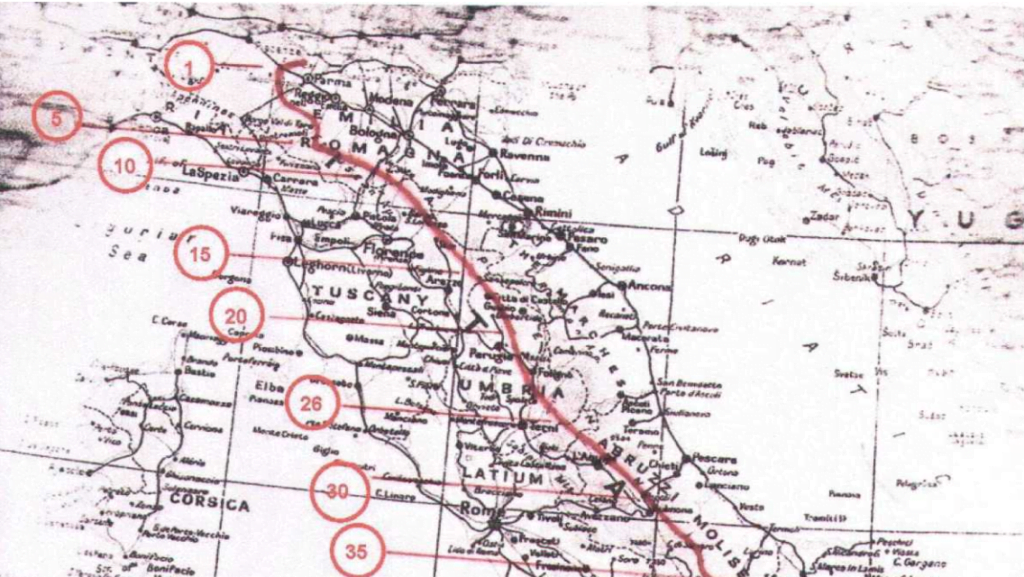
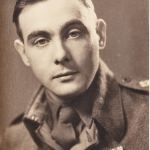
Sir David Carol MacDonnell Mather (known as Carol Mather) (1919–2006) MC was a Captain in the Welsh Guards at the time of his escape from PG 49 Fontanellato on 9 September 1943. He had served as a liaison officer on General Montgomery’s staff at the time of the Battle of El Alamein but was with David Sterling’s SAS when he was captured on 20 December 1942 in North Africa. He teamed up with Lt Archibald Hubbard of the Rifle Brigade the evening of the escape and this letter, written on the troopship home on 31 October, recounts their 38-day journey south, arriving at the Allied lines near Casacalenda on 17 October 1943. The letter formed the basis of chapters 30–32 in his war memoir When the Grass Stops Growing (1997), republished as With Stirling’s SAS in the Desert in 2021. Mather was Conservative MP for Esher 1970–1987.
The full story follows, in two versions. The version in the first window below is the original scanned version of the story. In the second window below is the transcribed version in plain text.
[Digital page 1, original page 26]
31st October 1943
LETTER NO 3
When the news of the Armistice came I was sitting in our room in a deck chair after dinner, reading Hardy’s “Jude the Obscure”. Someone said that the Itis [Italians] seemed a bit excited outside. “Oh, I suppose I’ll have to go and look,” I thought, “it’s obviously nothing at all.” From the lavatory window there did seem to be a certain degree of activity. Soldiers were talking in groups – always a good sign. Cycles were whizzing past and officers were walking nowhere in particular rather fast. It was the Armistice!
We were all hustled down to the hall and the SBO [Senior British Officer – Lt Col. Hugo de Burgh] made a speech about not getting excited. The next morning we didn’t have the usual 8.30 roll call but had a parade at 9 o’clock. We were told that German troops were in the vicinity. If they were seen approaching the camp by Italian scouts, we would march out and hide until they had passed. Everyone was to be ready to move at five minutes’ notice. When the English alarm call was blown we were to form up in our companies outside in the field. In the meantime the British had landed at Pisa, the Germans were attacking the Italians in Parma, and the Italian camp staff would defend the camp against all comers!
At midday, as we were all sipping our vermouth, the Italian guards outside suddenly jumped down and got into the big ditch – five got into the pigsty with a machine gun. There was much shouting. The alarm blew, and within five minutes we were marching out into the fields in our four companies. Eric Newby, who had a bad leg, was riding a pony. A German aeroplane came over us very low and we all scattered and lay flat.
It was a hot September day, and two hours took us to our hideout. We sat down under the vines and thought “Well, suppose we’ll be back in camp to-night and within a couple of days we’ll be on our way by plane or ship to England.” It didn’t feel like freedom at all.
In the late afternoon we heard that the Italian Commandant had been captured by the Germans and they had occupied the camp and were searching for us; also that they had occupied Parma and that the British had landed at La Spezia.
Archie Hubbard and I saw that there was no safety in numbers, so when the moon rose, without a word to anyone, we crept away. Our first stop was at a farm where we changed our uniform for peasants’ clothes. We sat at the long kitchen table and decided our route. We meant to do a night march, cross the main arterial road running from Parma and the South up to Milan and the frontier, which was crowded with Germans getting out we were told, and then make for the Apennines before La Spezia. There in the hills we would be safe until we could cover the 80 miles to the coast.
These contadini had no bitter feelings against the English. The old mother went to the chimney piece and gave to each of us a Madonna, for the journey, she said. Then two eggs each and a loaf of bread.
“Which way is west?” I asked the old man as we left, “There, towards the moon,” he answered, “but remember, sempre in campagna, niente strade, sempre in campagna. Auguri – God bless you! “Auguri – Auguri” they called as we walked away. “Now we must go fast and try and cross this road as quickly as possible, and try and make the Apennines before daylight because we probably will have to lie up tomorrow,” said Archie. “Yes, if we go towards the moon now – what is it, about 9 o’clock? – and gradually go to the left of it until about 3 a.m., then we should be aiming a good hand’s space to the left. Pity we can’t see the stars, hope the moon lasts out.” “Well,” Archie mused, “in three days’ time we should be home OK, maybe quicker, and thank God we left the others.”
By one o’clock in the morning we’d crossed one railway line and were lying under a hedge on the main road. German guns were rattling along the road a few yards above our heads, all going north. During a lull in the traffic we slipped across, another railway line and then sat down and ate a bunch of grapes.
[Digital page 2, original page 27]
At 3 o’clock we arrived at the foot hills, and the moon disappeared, and so we lay down by a small stream and slept till dawn.
The next day we were within 30 miles of Spezia and managed to listen to the English news. Nothing had happened – not a smell of a landing anywhere. We moved on to another farm for the night with an Italian soldier who said he wanted to come with us. After dinner until midnight we sat under the full moon with the peasants and peeled Grano Turco – maize, and sang. We slept in the hay and early the next morning our friend left, saying he was going to get news. This was just the chance we had been waiting for, so packing up our haversacks we hopped away into the hills. We were pretty certain he was a Fascist and had gone to betray us.
It was then we decided that we must make for Naples. It looked a long shot, but we might get through. We would keep in the high mountains the whole way. It might take two months, at an average of 20 miles a day.
After a week of walking we dropped down one evening to a remote village. We were invited into the house of an old Nona – grandmother, who gave us her last of everything. Nona was a gay old spark, aged 75, with one eye. Her two granddaughters came to laugh while we ate fried eggs, onions and tomatoes and drank a bottle of raw red wine. “To-night,” chuckled Nona, “you sleep with these fine young girls, one with one – eh,” she croaked, “is that not right, is that not as it should be – one with one, uno con uno, e bene, e vero?”. “Si si, molto bene,” we nodded, “Oh God, anything for peace, we can’t refuse.”
We slept peacefully that night and stayed all next day to rest our feet and heal our blisters and mend our tattered clothes. The following evening, whilst Nona was feeding us, a cobbler who had heard we were there, came and gave us a beautiful folding road map of the whole of Italy, and planned us a route.
At Cerredolo the bells were ringing for Matins. We sat and waited in the shade of a vine. Then all of a sudden out of the church came running hundreds of little black figures. They crowded round us like a swarm of ants, all talking together. “Oh you are English! They are two Englishmen.” “You are fugitives. They are fugitives escaping from the Germans, sone fugitivi dai Tedeschi.” “Look how fair one is, the other looks Italian.” “Come, you must come with us, we will hide you in a wood. It is too dangerous for you to go to Naples – it is impossible, too far, too dangerous. We will give you food, if you are hungry. You must stay a week, or two weeks in our wood where we will feed you. We are all friends of the English. We are all to be Missionaries in China after the war, where are plenty of English. Brother Petro, some water, acqua fresco. Fratello Petro will get you some water. We have no wine but water is better. Now you must eat.” They all bustled around like little black wasps, with young beards just growing, and white sun hats on their heads. When we were hidden in the wood they skipped away, and in two minutes were back again bearing plates of salad and meat, fruit and bread.
“Now, mangiare, eat, and we will talk.” No, brother, they are tired, we must go away, but two of us will stay.” “You must stay for a month in the wood.” “No,” we explained, “we must walk towards Naples to meet our friends and must go on this afternoon. You are kind and we will rest till four o’clock and then must go.” They brought out eiderdowns and pillows, and rather unwillingly we lay down for we were still fresh, but it was peaceful. At 4 o’clock sixteen black figures came scrambling up the hills, sweating and breathless. “Oh, we have such bad news for you,” the Germans say on the radio that anyone who helps English prisoners will be shot; English and Italian soldiers must report to them within 24 hours, otherwise they are outlaws and may be shot.” “We have fear, it is better for you to go. You must become pastorelli, shepherds on the high mountains. There you will be safe. All the day you must watch sheep. You must go by Castelnuovo Firenzuolo, Santa Maria, San Benedetti in Alpe and then in montana you must be pastorelli.” I thought I had never seen such kind faces. I seemed to recognise some as the faces of friends whom I had known long ago, but perhaps it was just a sudden impression created by so strange a meeting.
[Digital page 3, original page 28]
“Now you must go, we will pray for you every day, and you must pray also. You must also pray for us. We may be taken by the Germans, we don’t know. Brother Gregory will accompany you to the first village.” “We may see you perhaps in China,” we said, and followed Brother Gregory.
Many Italian soldiers were walking towards their homes, and so fugitives were not a strange sight to the peasants. Although we spoke such a little Italian, many of the contadini thought we were Italians from another part of Italy: Alt Italia or Sicilia or some other outlandish part, where the language was different and men were even fair. It was some time after we had eaten dinner and slept at their farm that it only just dawned on them that we were English, but how could we be here? It was true that some Inglesi had landed somewhere – miles away in Sicilia – was Inghilterra the same country as Egitto? No, it was altogether not possible that these two poor soldiers should not be Italians. But where are your casa, your homes? Homes in Inghilterra? How long on foot to Inghilterra? Two months or more! Pauvre ragazzi – poor boys. But they must be a little foolish, perhaps shaken by the ugly times – two or three months to their houses! And have you mamas and papas? Three years since you last saw them! Pauvre ragazzi – poor boys, poor boys. Quel miseria. Bruto tempo – ugly times, ugly Germans.”
They never quite realised that we were English prisoners of war, although we explained as clearly as we could. After a consultation they sometimes said, “We are all Christians, all God’s children, so what does it matter?” Then perhaps the old woman of the house would cry.
By the time we had left these friendly casa we were almost in tears ourselves, thinking “pauvre ragazzi, poor us, poor boys, what misery, what ugly times – the bad, the wicked Germans – bruto, bruto, bruto!” Perhaps it was better that we should not laugh when they said these things and not look as though we were really rather enjoying ourselves. Perhaps it was right that we should pity ourselves. It was altogether wrong that we should go through Italy dancing and singing, even though the children did follow us like the Pied Piper. So after that we made a point of looking particularly morose on such occasions and murmured “pauvre noi”.
Every two days we usually had a fairly main road to cross, a river and sometimes a railway. We usually did these crossings in the early morning about dawn, when there was little traffic about. Soon we struck into a belt of miserable country – not high mountains but a series of precipitous wooded ridges rising up to 3,000 ft. It meant traversing three or four of these a day to get a good mileage in. Here the casa were few and far between.
The farmers got their livelihood from their few acres of chestnut trees and grew enough maize to keep them in bread. We ate bread alone, washed down with water. We were never very welcome guests and had to ask for our food and rest. Archie got neuralgia and I strained a tendon climbing. Then one day, after we had been travelling for three weeks, we sighted more open country in front, and that night we dropped down into a beautiful valley full of grapes. We had picked out our casa from a few miles away and it turned out a lucky choice. We got gloriously drunk that night and were given meat for dinner and potatoes. Then slept like logs in the hay.
Up till then we had had fine hot days, in fact it was a drought and walking was hot but firm going, but during our drunken slumber at the farm in the valley of the grapes, it rained cats and dogs. That morning we had meat again for breakfast and Archie got a long-needed shoe repair, and we started off at 9 o’clock.
One day was very much like another. I have a diary of all the days but it is not worth quoting. We gradually crept along, pleased with our progress and dead tired each night – that tiredness that cannot be enjoyed, when a fire, a pipe and food cannot be appreciated and sleeping is not oblivion but a long fidget and scratch. I remember one day we walked 35 miles and slept in a stall with oxen; another I was stung by 12 wasps in the head; Archie lost his hat; I lost my watch; we got drenched in the rain or met a kind old woman. One day, sheltering from the
[Digital page 4, original page 29]
rain I looked out of the window and saw two armed Carabinieri coming down the road by the house and I pointed them out to the man, He told us to be quick and follow him and he rushed us down to the cellar but opened a door at the bottom, and before we knew where we were we were out on the road, with the man saying “Via Via – away away”. The door slammed and the Carabinieri turned the corner 15 yards away, so we walked away whistling, and they said nothing.
So we walked on, and after four weeks had done over half the distance. Then we began to climb the great mountains that lead to the Gran Sasso d’Italia, over 10,000 ft high. Once we had crossed this we would be within about 100 miles of the fighting. In those mountains we saw and heard of a lot of other prisoners making their way down or lying up. They were high pasture Alps where friendly shepherds lived. It was quite usual to be walking along and be hailed by a shepherd – “Hey, youse guys, whar’s you agoin? Well, goddam youse, all the way from Parma! Son of a bitch, that’s a mighty long way, by Jimeny.” In fact, later on, it was a question of having to stop every few kilos to talk to some old boy who’d lived in America.
The morning we crossed the Gran Sasso we had only managed to get three potatoes to eat, but after climbing for five hours we passed over at 9,000 ft in a mist. On the other side we sat down with a shepherd lad and discussed the fine panorama to the south west. There was Aquila with the long valley cutting down Italy which held the road and railway and many Germans. There was San Stephano way below us and the route we were to take – following just inside the Gran Sasso range as it curled down towards the south west and Chieti. When we had dropped down to San Stephano that night we were guided to a cave where we found two British soldiers. We ate enormously there and curled up under their warm blankets. The guests were not allowed to sleep together, but Archie slept with Mac in his bed and I slept with Jim in his, which was a pleasant change. The next morning before it was light, we splashed in the stream in the woods, stuffed as much cold macaroni into us as we were able, and were off into the hills by first light – across a high plateau all day and down into a fertile valley by evening, Here were no isolated farms, and Germans were stationed in the villages, so we found a cave, collected many grapes, nuts and tomatoes and lay eating on the grass outside our cave by the light of the young moon. Then we robbed someone’s wood pile and built a large fire inside the cave and slept as best we could curled round the fire.
The following evening we sat in a farm just above the Rome–Pescara road, the ancient Via Tiburtina. The old padrone or master of the house, aged 78, was demonstrating to us a negro dance which he had seen in America fifty years ago, but we still had our thoughts concentrated on the road below us. It was the main German lateral communication between both the fighting fronts. Besides the road, there was a railway and a swift and deep river – the Pescara, so it was undoubtedly a line which they would attempt to hold sooner or later. For us, the sooner we were across this obstacle the better. Once beyond this line it was about a week’s marching to Campobasso, which we believed to be in our hands. The obstacles ahead included five rivers, several roads and one big range of mountains – the Maiella, which rose to 8,000 ft.
“The road is dangerous,” they said, “Aspett – wait, wait for only two days and then your friends will be here. Only wait and we will feed you in a cave, otherwise you will be taken by the Germans.” We had heard this advice so often that we were almost tempted to stay, but we also knew that once winter had come and our troops had not advanced, we would be stuck. Always we were warned of the dangers that lay in front of us, and always they had melted away.
We lay and watched the German transport crawl by from a high wooded eminence for three hours. Where the railway crossed the river there was no guard, and so we would cross there, then follow the river bank down for 200 yards and turn up in a fold of the ground and cross the main road. I would cross first and wait for Archie the other side. We both crossed safely and took shelter from the rain in a casa only 300 yards away from the road. It went on raining and we accepted the people’s hospitality and ate well. The manager of the local power station, an evacuee from Naples, also lived here and his family.
[Digital page 5, original page 30]
Archie and I and the cowboy were put in a double bed next to the main room. We went to bed early, and soon afterwards the watchdog started barking and the manager of the power station ran out and said to two figures in the dark, “No fear, there are no Germans here.” It was a pity that the two figures were German soldiers themselves and that furthermore they came into the room next to ours and demanded olive oil. We were very tired and so we just lay quietly listening. We could hear every word they said. Our host was sensible and they left within a few hours, and we slept undisturbed except for the fleas which bit like dogs.
On the 37th day of continuous walking we called in at a farm for directions. All the women were in tears – “There are Germans everywhere, they take everything. From here one hour ago they took a sheep. They are now at the farm below. What ugly times! Mama mia, when will it finish? Madonna, madonna – poor us, poor us!”
Later in the day we were directed to a farm which was said to contain an Englishwoman. We said to her at the door, “Abbiamo sentito in questa casa abita una donna qui parla Inglesi.” She answered in peasants’ dialect, and then said, “Careful, kids, don’t look now but there are twelve Germans on my left by the river. This is the last zone of operations before they take up their new line. Don’t look, but walk slowly up the hill – go now or they will see you.” “Appalling state of windiness these people are in,” we said as we left, “why, we have hardly seen a German all day.”
As we turned a corner of the track Archie suddenly whispered “stop”. There ten yards in front were two Germans on horses. We turned abruptly round and slouched down the hill, not knowing if they had seen us, only to hear foot steps quite close behind, so we dodged behind a hedge and lay flat. Two infantrymen passed within a few yards. We lay there for half-an-hour and made across an exposed hill towards some cover beyond. As we were right in the middle of the open patch there was a great deal of shouting behind, and three Itis were running after us and yelling at us to stop. “Bloody fools, idiots, they’ll give the whole show away, don’t they realise there are Germans about!” We dived into some bushes and lay flat as the first one came running up. “Kamarad, Kamarad!” He embraced us, “Ich bin Deutsch, ich Deutsch”. “Aspett, Aspett,” shouted the other two as they came crashing over the sky line – “Abbiamo qui un soldato Tedesche!”
“I’m an Austrian from Vienna! My father owns a farm. My brother is in London. I must come with you to the English!” Yes, said the Italians “we must all come with you to the English!” They are only two kilometres away. It will only be one night. We know the way. We have a friend who knows the way.”
Archie was superb. He told the deserter we would have nothing to do with him. He must leave at once. He was a fool and an idiot. Didn’t he know there were Germans about? “Yes,” said the German, “I know where are the Germans. I will show you where they are.” We quite decided to have nothing to do with them, and then we thought we might question them more closely; they seemed genuine enough. The Austrian said he knew all the dispositions. The long wooded ridge above us was the German front line. On it we would find only 50 men armed with nothing larger than LMGs [light machine guns]; they would be scattered in twos and threes on the tracks through the woods. Beyond that we would find no Germans. We would walk two hours to the river Bilferno and we would be within our own lines. The Italians said at their uncle’s house there was a man who knew the country intimately who would guide us across. We pondered – yes, it was worth risking perhaps; we would at any rate talk to the guide. The German would stay with us in the rushes and one of the Italians would go to his uncle’s house and fetch his friend. We would wait one hour.
Three hours after darkness fell there was a faint shout from below. “Oyee eee!” shouted back our Italian. Then followed a conversation in shouts about guides and uncles, deserters and Englishmen. The situation was past our control. We all trailed down to the faint voice below, which increased in volume as we decreased the distance. When the unknown voice was reached it suddenly broke into a whisper “Tacete,” it said “Sshh, quiet, Germans are everywhere, don’t say a word, it is impossible for you to move tonight! Tacete!” It was too much – the German, Archie and I burst our laughing and left. We would not commit ourselves; we would follow the German for a short while and then he must go on by himself. Soon he began to swing to the right, he was corrected, and it happened again. “Now it is
[Digital page 6, original page 31]
better for you to continue alone – we will wait until the moon rises.” He embraced us again, thanked us a million times for the note of identification we had scrawled for him with a match head, and disappeared into the darkness.
“Whew! Well now we start all over again,” we thought.
It was a particularly dark night, and having stumbled upon a farm we invited ourselves to dinner – eggs, wine and macaroni, and an old man who offered to take us by an unknown track through the woods to the top of the wooded ridge. “Pauvre ragazzi, pauvre ragazzi” murmured the old woman who stoked the fire. “Ah, what ugly times, what evil days – no shoes, no food, nothing. Scarpe Mussolini!” She pointed to the bits of old motor tyre tied round her feet, “Mussolini shoes! Bad, wicked fascisti – bruto. When will all this misery end?” “If we get back,” we answered “we will send you some shoes and soap and wool.” “Poor boys, poor boys.”
The old man led us well and we passed swiftly through the trees. Over the top was a clearing and here he told us that we must walk towards the guns we saw firing, for they were ours. We gave him our tobacco and bade him goodnight.
It was a soft moonlight night and we walked well. We avoided certain bridges and villages we had been warned about, and at three in the morning we waded across our 30th and last river, the Biferno. Once on the other side we sat down under poplar trees and ate some bread. Ten miles further on was the Termoli-Campbasso road which we decided to cross, if possible, before daylight.
At a farm on the hillside stood three men talking. It was odd that they should be doing so at four o’clock in the morning. Perhaps it was a German outpost. We stalked up close enough to overhear their conversation – they were Itis all right. They said we were within our own lines. One of them said he would lead us to a gun. He was a little man in a long cloak and a billycock [bowler] hat on his head. Halfway up the track he stopped. He hopped twice into the air and said “Liberi! liberi! You are free, free! No more Germans, Tedeschi finito, have no more fear!” Then he did a little dance lasting for a few seconds, pointed to our gun and disappeared.
It was a good long climb and then we saw the back of a camouflaged truck. A voice said “Alt!”. Our hearts sank, then ‘’Oo goes there?””Friends,” we quavered, feeling we looked anything but it. “Ad-vance one and be recognised.” I stepped forward and said in a kind of nonchalant tone “Escaped prisoners of war”.
We were given cigarettes, and as the officer was still asleep we walked on to Brigade HQ. Here we were officially arrested and then released, and as the duty officer was still asleep we hung about on a railway siding until a kind soldier took pity on us and gave us a bed till daylight in a railway truck. Then we had an immense breakfast in the officers’ mess.
We got a lift down to 8th Army HQ and met many friends. It was hard to change quite suddenly from a gypsy to an officer, and the transformation was only half complete after we had bathed and changed. The first night Archie slept in Monty’s caravan. I found him the next morning lying back in what had been General Messe’s bed, with the plan of campaign on his knees sipping early morning tea – the change was almost complete.